

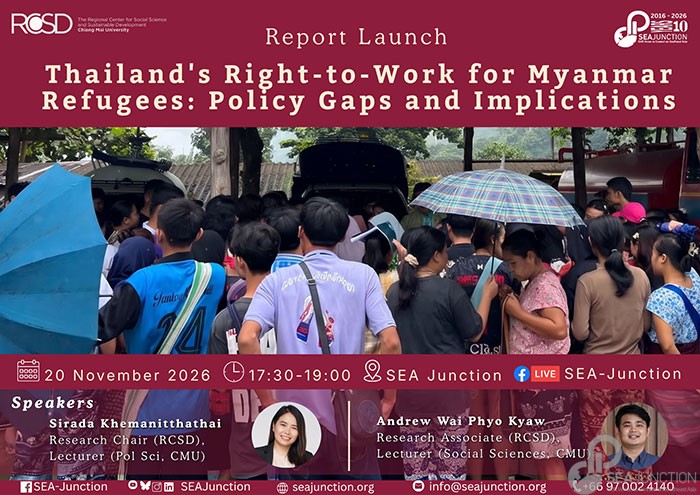
Thailand’s Right-to-Work Policy for Myanmar Refugees: Policy Gaps and Implications
November 20 @ 5:30 pm - 7:00 pm
Event Description
Join us for the launch of a new report by RCSD examining the challenges and gaps of Thailand’s Right-to-Work Policy after its first year of implementation. The report launch will take place on 20th November 2026 from 5.30 – 7.00 PM at SEA Junction. The researchers will present their findings on from the new report, focusing on access to safe and decent work. The discussion will explore lived experiences of refugees, particularly on barriers to implementation, and recommendations to strengthen labor rights and protection from exploitation. Economic inclusion for refugees and host communities will also be discussed.
On 26 August 2025, Thailand’s Cabinet approved measures enabling eligible displaced persons from Myanmar living in nine temporary shelters along the Thai-Myanmar border to seek lawful employment in Thailand. The policy marked an important shift from the long-standing exclusion of camp-based refugees from formal employment. It was designed to respond to labor shortages in sectors and locations where employers struggle to recruit, address cuts in humanitarian aid, and strengthen refugees’ capacity for self-reliance.
The policy framework allows eligible individuals to apply for authorization to leave shelters and obtain work permits valid for up to one year, subject to specified administrative, health-insurance, employment, and mobility requirements. Implementation began in October 2025 through a process involving employer selection, applications to provincial employment offices, authorization to leave the shelters, health checks, health-insurance registration, and work-permit issuance.
This study marks the first anniversary of Thailand’s Right-to-Work Policy and examines its implementation and the experiences of Myanmar refugees living in nine temporary shelters along the Thai-Myanmar border. It explores whether the policy has helped refugees access safe, voluntary, and decent work, and identifies the challenges and gaps faced by refugees and their families during the first year. The study also considers how Thailand can improve the policy to better protect refugees from exploitation, support their freedom to choose where and how to work, and promote positive contributions to local economies and host communities.
This event will be in English and livestreamed on SEA-Junction Facebook Page.
For more information, please email: info@seajunction.org or phone/wa: +66970024140
NB: The event is free, donations are welcome to support SEA Junction activities.
Organizers
SEA Junction, established under the Thai non-profit organization Foundation for Southeast Asia Studies (ForSEA), aims to foster understanding and appreciation of Southeast Asia in all its socio-cultural dimensions, from arts and lifestyles to economy and development. Conveniently located at Room 407-8 of the Bangkok Arts and Culture Center or BACC (across MBK, BTS National Stadium), SEA Junction facilitates public access to knowledge resources and exchanges among students, practitioners and Southeast Asia lovers. More information at http://seajunction.org/.
The Regional Center for Social Science and Sustainable Development (RCSD) was established as an academic unit under the Faculty of Social Sciences, Chiang Mai University in 1998. By linking graduate training and research to development theories, policies and practice, RCSD aims to create a deeper understanding of the social, environmental and cultural challenges of modernization and development processes, in particular the impacts of the processes of regionalization and economic integration on local people and the environment.