
Small Grant Program “Staying Healthy and Resilient Amidst Conflict in Myanmar”
In Myanmar, a convergence of crises—shaped by state violence, armed conflict, economic contraction, displacement, and institutional breakdown—has severely affected public health, the functioning of the health system and the country’s capacity to deliver health education and services. The deliberate weaponisation of healthcare has further eroded access to services as injury and disability continue to mount. Affected communities show heightened levels of psychological distress, anxiety, and depression, while widespread imprisonment and torture remain a source of deep trauma. In conflict-affected and hard-to-reach areas especially, access to even basic health services remains extremely limited, widening the divide in quality of care and quality of life among populations with differing levels of security and freedom of movement and between urban and rural communities. Within this protracted crisis, marginalized groups, including internally displaced people, people with disabilities, disadvantaged women, members of gender and ethnic minorities and survivors of violence, are especially vulnerable.
Addressing health equity in Myanmar therefore requires an integrated approach that recognizes mental health, disability and gender and ethnic inclusion as core components of health system strenghtening and recovery. As violent conflict and armed struggle increasingly harm health and health equity across the country, it is urgent to highlight and address the health challenges faced by survivors of violence and by marginalized communities living through conflict-related crises, and to encourage their participation in responses that impact their lives and wellbeing.
This recognizes that survivors and affected communities are not passive victims of external forces. Even in times of violent conflict, they remain resilient mobilizing their scarce resources and available preparedness mechanisms to overcome adversity. In their struggles, they are supported by civil society and grassroots organizations through short-term community efforts as well as longer-term strategies aimed at promoting more sustainable solutions and systems.
It is within this contextual and strategic framework that SEA Junction, in partnership with CMB, will open the six round of its grantmaking program, this time focusing exclusively on advancing health and health equity in conflict-affected contexts in Myanmar, particularly when related to violent and armed . The 2026 “Staying Healthy and Resilient Amidst Conflict in Myanmar” grant-making initiative funds efforts directed at improving health, health equity and health systems for conflict-affected communities and survivors of violence. These include a wide range of activities ranging from building knowledge and socio-cultural and artistic capital for health and wellbeing, strengthening health resilience, improving the living and health conditions of conflict-affected local communities (geographical as well as functional) and enhancing their capacity to cope with the current conflict and its longer-term health impacts.
NB: As the application, selection and disbursement time will take at least 3 months, this program is for longer term response, not for immediate relief or medical treatment.
Grant Size and Scope
Micro grants for an average of USD 1,800 will be awarded to selected groups and, exceptionally, to individuals (primarily in the arts and media) located and operating in conflict-affected contexts. For this round, two larger grants up to USD 8,000 will also be available for more established local organizations. Funds can be used to complement existing institutional resources as well as seeds or matching funds.
Besides providing financing, the program also shares relevant resources, fosters cross-fertilization of ideas and interventions, helps build networks and conducts joint advocacy activities.
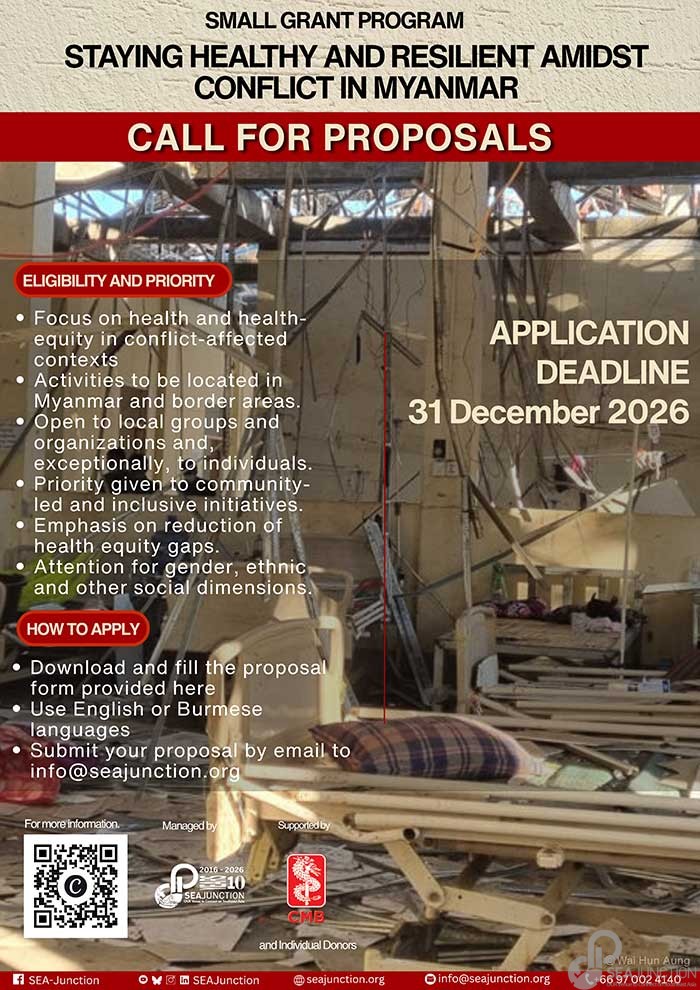
Eligibility and Priority:
- Focus on health and health-equity in conflict-affected contexts
- Activities to be located in Myanmar and border areas.
- Open to local groups and organizations and, exceptionally, to individuals.
- Priority given to community-led and inclusive initiatives.
- Emphasis on reduction of health equity gaps.
- Attention for gender, ethnic and other social dimensions.
Selection criteria:
- Quality of proposal.
- Urgency of problem to be addressed and suitability of proposed intervention.
- Strategic value and contribution to health equity.
- Attention to people’s and program narratives.
- Feasibility of project within time and budget.
- Expected outcomes, innovativeness; accountability; strength of references.
In the selection, we will further ensure diversity in terms of countries and localities, identity criteria such as gender, and types of activities.
 NB: Use of generative AI is not allowed.
How to Apply:
- Download and fill the proposal form provided here: Proposal Template
- Use English or Burmese languages
- Submit your proposal by email to info@seajunction.org
Application Deadline: 31 December 2026 (23:59 UTC +7)
Managed by SEA Junction
SEA Junction, established under the Thai non-profit organization Foundation for Southeast Asia Studies (For SEAs), aims to foster understanding and appreciation of Southeast Asia in all its socio-cultural dimensions- from arts and lifestyles to economy and development. Conveniently located at Room 408 of the Bangkok Arts and Culture Center or BACC (across MBK, BTS National Stadium), SEA Junction facilitates public access to knowledge resources and exchanges among students, practitioners and Southeast Asia lovers. For more information see www.seajunction.org, join the Facebook group: http://www.facebook.com/groups/1693058870976440/ and follow us on twitter and Instagram @seajunction.
With support of CMB Foundation
Founded in 1914, CMB Foundation is an independent American foundation. CMB’s mission is to advance health, equity, and the quality of care in China and Southeast Asia. Working in a spirit of partnership at the forefront of strategic philanthropy, CMB strives to build capacity in an interdependent world that fosters innovation in professional education, policy research, and global health. For more information see www.cmbfound.org