


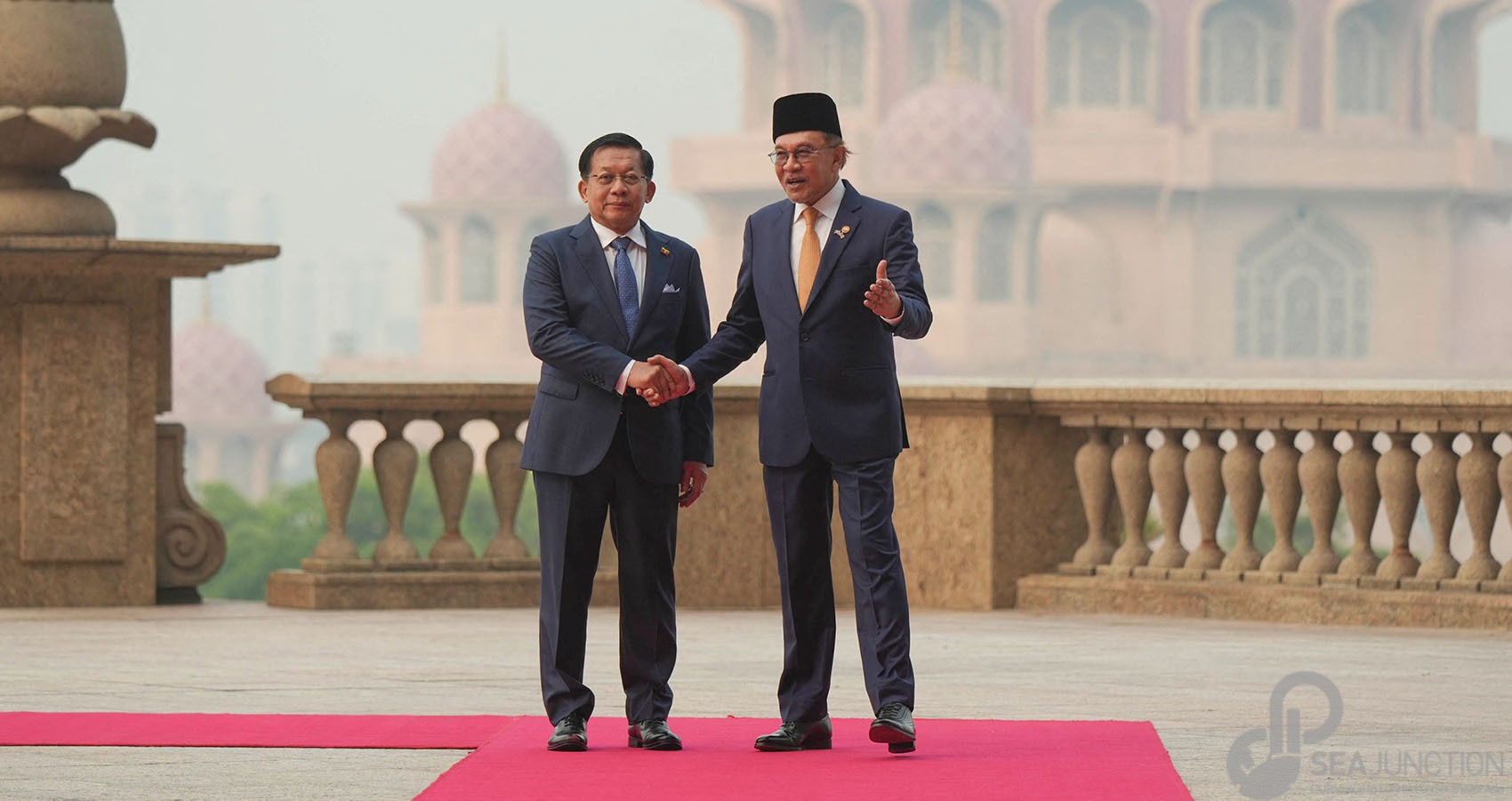
Myanmar’s junta leader-turned-president, Min Aung Hlaing (left), shakes hands with Malaysian Prime Minister Anwar Ibrahim during a welcome ceremony at the prime minister’s office in Putrajaya, Malaysia, on October 8, 2026. / AFP
Two events in the last week of September are emblematic of the opposite realities confronting the Association of Southeast Asian Nations (ASEAN). The first was Malaysia’s deportation of 1,476 Myanmar refugees aboard Myanmar Navy vessels. This initial phase of a bilateral agreement covering 5,000 returnees in total, among them Rohingya, arguably violated the customary international law principle of non-refoulement, given the dangerous conditions awaiting them on arrival. That Myanmar authorities supplied the list of approved returnees heightened concerns that it may have included political opponents of the regime, who face the risk of persecution, and young people targeted for forced conscription. Moreover, because the refugees were taken from immigration detention centers, it is doubtful they consented to voluntary repatriation.
The plan’s architect, Malaysian Prime Minister Anwar Ibrahim, once a defender of the Rohingya, a strong critic of the junta and an opponent of readmitting then-junta chief Min Aung Hlaing to the ASEAN fold, has unapologetically reversed his stance. He readily engaged the former general, now a self-styled president after a discredited election, to help carry out the deportations, in what many see as a nationalist bid to regain popularity ahead of Malaysia’s next general election. Min Aung Hlaing’s subsequent visit to Malaysia on October 7-8, at Anwar’s invitation, gave the disputed leader, who faces an International Criminal Court arrest warrant request over crimes against humanity committed against the Rohingya, the legitimacy he craves. Further concessions, including helping in the reintegration in ASEAN, were in the pipeline.
On September 28, just one day before the deportations, the Myanmar military bombed a crowded market and the nearby Kissapanadi Bridge in Kyauktaw Township, Rakhine State, killing 50 civilians, mostly women and children, and wounding 60 more, many critically. This is the same state to which any deported Rohingya would be expected to return. Now largely under the control of the insurgent Arakan Army, Rakhine State has faced a regime air campaign against civilians that has been escalating since April, in defiance of the professed shift to civilian rule.
The engagement with a regime-ravaged country expresses ASEAN’s duality. On one side, member states, motivated by economic and geopolitical interests, are increasingly eager to put the conflict behind them. On the other, it is difficult to ignore Myanmar’s unwillingness, even for appearances’ sake, to meet the remarkably modest terms of the Five-Point Consensus. This peace plan, which ASEAN leaders agreed with junta chief Min Aung Hlaing in April 2021, a few months after his military coup, calls for an immediate end to violence, constructive dialogue, humanitarian assistance, the appointment of a special envoy, and envoy visits to Myanmar to meet all stakeholders. From the start, the junta ignored these commitments so thoroughly that, by October 2021, ASEAN had taken the uncharacteristic step of barring Min Aung Hlaing and other political representatives of the regime from its summits, departing from a strict reading of the bloc’s principle of non-interference in members’ internal affairs.
Since then, violence has not ceased, but rather intensified. According to the UN Office of the High Commissioner for Human Rights (OHCHR), airstrikes have become deadlier, killing at least 982 people in 2025, including 232 children: a 52 percent increase over 2024. Overall, the independent monitoring group Armed Conflict Location & Event Data (ACLED) has put the toll at more than 100,000 people since the coup. The calls for the release of all political prisoners, which ASEAN diplomatically said it had “heard” without the Consensus spelling them out, remain unheeded by the junta, as does permission for the Special Envoy to meet all parties. Aung San Suu Kyi is still unreachable, even if supposedly detained at what the regime calls a “designated residence”, and of the more than 32,000 people arrested, the Assistance Association for Political Prisoners (AAPP) confirms that nearly 15,000 remain in detention, while nearly 7,800 more cases are pending verification.
Yet ASEAN member states are shifting toward normalizing relations with Myanmar. Laos was the first in the region to break Min Aung Hlaing’s ostracism, inviting him for a state visit on July 3. This move followed the example of India and, above all, China, Laos’ dominant ally, both of which welcomed him after the junta-run election. China, in particular, has a stake in promoting the regime’s international acceptance, having backed it financially and strategically and helped it restrain armed ethnic and opposition groups. It was Thailand, though, that signaled a clear departure for the region by receiving him with full honors.
The pomp of the visit, including a red-carpet welcome and a formal guard of honor at Government House, went well beyond the “calibrated engagement” officially given as its rationale. The unfulfilled Five-Point Consensus was overlooked, and no harsh reprimand was issued over the conflict’s cross-border spillovers: scam centers, human and drug trafficking, irregular migration, pollution from gold and rare earth mines, and border intrusion by Myanmar jet fighters. Instead, a sumptuous banquet with Thailand’s main conglomerates signaled unstated economic motives, notably border trade, infrastructure investments and access to natural resources.
Other mainland Southeast Asia countries with close geopolitical and economic ties to China, namely Cambodia and Vietnam, soon followed. Malaysia’s change of course, prompted by internal political developments, now also opens the door to wider regional engagement. So far, only two maritime Southeast Asian countries have spoken out strongly against the trend. Singapore, despite (or perhaps because of) being one of Myanmar’s main investors, wants a real solution and has called for measurable steps towards implementing the Five-Point Consensus, including a permanent cessation of violence, the release of all political prisoners and unimpeded delivery of humanitarian aid across Myanmar. Timor-Leste, Southeast Asia’s youngest democracy, continues to push for accountability and has initiated legal proceedings against Myanmar for war crimes under the principle of universal jurisdiction.
The remaining member countries, however, are starting to waver. Analysts speculate that the Philippine foreign secretary and ASEAN special envoy, Theresa P. Lazaro, who is set for a humanitarian visit to Myanmar this month, is eager to show results by advancing the “normalization process” at the ASEAN Summit in Manila in November. She has already drawn strong public criticism for her January 2026 meeting with Min Aung Hlaing in Naypyitaw, even before the election’s results were known. And again for hosting the July 12 “informal meeting” in Bangkok of ASEAN foreign ministers, which the Myanmar regime’s Foreign Minister Tin Maung Swe attended, the first such interaction since the coup.
Indonesia, while still emphasizing the Five-Point Consensus, has also widened its engagement. A high-level delegation led by then Foreign Minister Sugiono visited Myanmar on June 8, met Min Aung Hlaing, and promised closer bilateral relations and cooperation in regional and international fora, declaring, as quoted by the Jakarta Globe, that “Myanmar is ASEAN family.”
This return to “business as usual” is, however, contested by civil society and allies of Myanmar’s people’s movements, who argue that there is nothing normal about a country at war with its own people. Such an approach would only create a false sense of regional security without addressing the root causes of the conflict or resolving it. Legitimizing the regime while ignoring widespread continued resistance and failing to protect the civilian population would only advance authoritarian trends endemic to the region and reinforce ASEAN’s reputation for disregarding human rights.
The recent photo exhibition “The Coup Years,” held at Dia.lo.gue in Jakarta from September 26 to October 11, and organized by SEA Junction with AJAR, Humanis Foundation and Migrant Care, offered a visual chronicle of Myanmar since the coup, documenting the dire realities on the ground, the tragic toll of the regime’s atrocities on civilians, and continued resistance to the military and the elections it backed. Experts, artists and activists reaffirmed their solidarity with the people of Myanmar and rejected ASEAN member states’ efforts to whitewash the regime’s continued crimes. At the opening panel, parliamentarian Mercy Barends, Indonesia’s AICHR representative Anita Wahid and ALTSEAN director Debbie Stothard agreed that ASEAN actually has a choice in strenghtening its allegiance to the 2008 ASEAN Charter, the regional body’s founding legal framework. The Charter places people’s will at the center and commits it to democracy, the rule of law, good governance and the protection and promotion of human rights. Here, Myanmar becomes the litmus test of what the “ASEAN Way” amounts to in practice and of whether ASEAN will uphold its constitutional principles or conveniently suffer amnesia about them.
Rosalia Sciortino is director of SEA Junction and former Asia regional director of the International Development Research Center (IDRC) and the Rockefeller Foundation.
An earlier version of this article appeared in The Jakarta Post.